One of my most meaningful ayahuasca ceremony experiences was witnessing the words of a healing song – an icaro – appearing as golden syllables issuing from the mouth of the curandero and gently floating down into my abdomen. In those long moments, I felt energetic reorganization happening in my body. And it was the first time in my life that I felt pure trust. This was revelatory and yet also the most natural feeling in the world. Strangely, it also felt like nothing at all. As I write this, I feel deep gratitude towards that healer, Dave, and the life-changing experiences his ceremonies offered me.
I’ve often experienced icaros touching into the deepest parts of my psyche and nervous system to stimulate deep healing, growth, and self-discovery. These benefits are commonly reported by people attending ceremonies led by Peruvian Indigenous Shipibo-Conibo practitioners and their apprentices. These lineages consider icaros to be central to the healing practice. Icaros are so fundamental, in fact, that it’s considered unnecessary for ceremony attendees to drink ayahuasca at all.
What follows is an exploration of Indigenous and Indigenous-informed perspectives on icaros. As with everything I share on this site, I aim to respectfully bridge Indigenous and Western understandings.
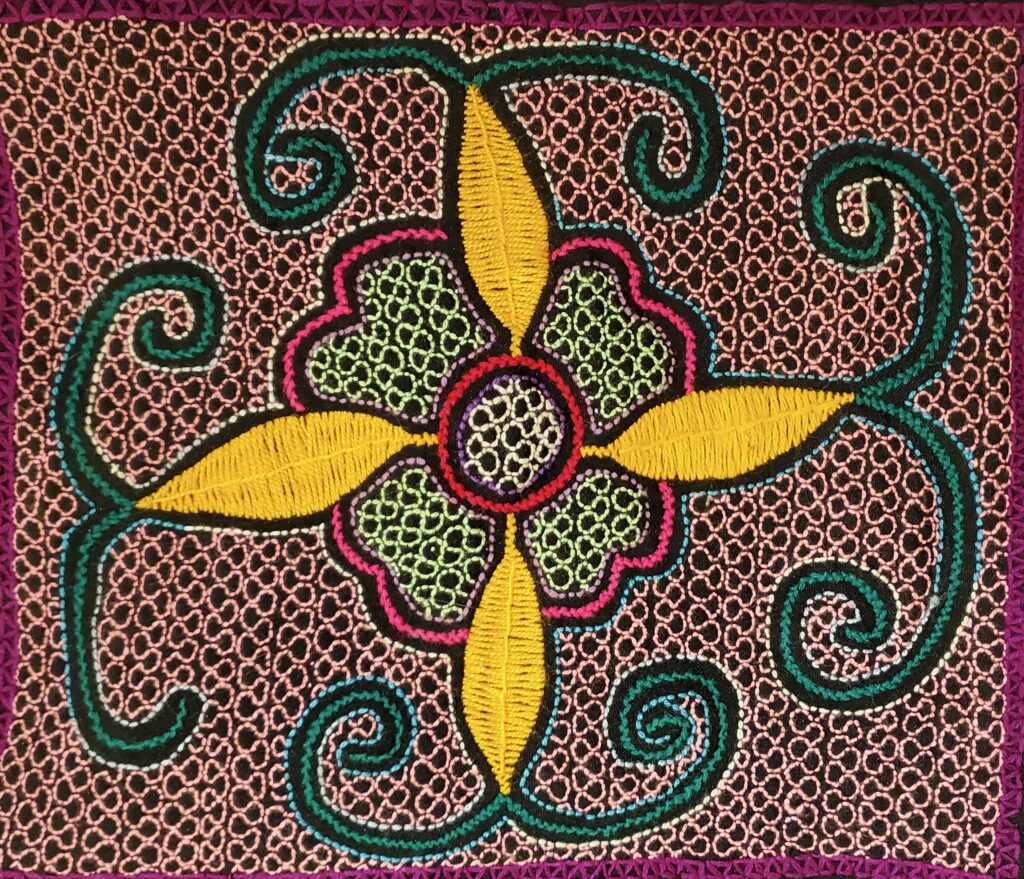
Textile by Miguel Muñoz (Llamancha, Perú)
Indigenous perspectives on icaros
Loosely understood as songs for discovery, diagnosis, and healing, icaros address the unique needs of each ceremony participant. They are transmitted to the onanya1 from the plants they’ve dieted and with whom they’ve maintained deep relationships.
In Trabajar con las Plantas Que Tienen Madres: Diálogos con un Onanya Shipibo, José López Sánchez describes icaros as “a language created by diets and plants that carries psychology, philosophy, spirituality, and all of one’s mental and energetic trajectories.”2 He elaborates that every icaro “is the melody and rhythm that one draws out through one’s diet, and it’s how one sings in that moment in front of the person” (López Sánchez et al., 2024, p. 105). Another Shipibo onanya, Soi (Castilian name Jorge Ochavano Vasquez), states:
Icaros are born from plants. They are transmitted by plants. Icaros only come when you are already connected with nature, with the four elements, when you are already connected physically, spiritually, and emotionally. Then, when you take oni [Shipibo for ayahuasca], the icaro comes. You are already connected to the energy of plants (Aronovich & Labate, 2021, p. 231).
From these perspectives, the icaros, the practitioner, and the plants are inextricably interwoven. My growing understanding is that singling out the ayahuasca and asking how “it works” is perhaps the wrong question, because all three elements (plantas, onanya, icaro) are necessary for healing.
How does the practitioner acquire icaros?
Onanyabo receive icaros through undertaking dietas. Dieting, which I’ve explored more extensively elsewhere, is a disciplined process of forming and tending to relationships with plants who are teachers. It’s a committed, relational practice of listening to what the plants reveal.
Over years of dieting, these relationships deepen into a vast body of living knowledge that undergirds the practitioner’s healing capacities. These abilities are most clearly expressed through the icaros that emerge from the plants themselves. When a practitioner is working in ceremony, the plants are identifying what requires healing and giving rise to the icaros the practitioner sings, which carry the plants’ energy into the healing space.
Icaros are multipurpose tools
Onanyabo use icaros for protection, preparation, assessment, and diagnosis. Icaros are also used for cleaning via release, “redesign,” and harmonization of energy.
Practitioners may begin their healing work by singing icaros intended to protect the ceremony space and the participants from malefic spirits, dark energies, and other harmful influences. Ayahuasca opens a portal to the spirit world such that the nervous systems of all present become open and vulnerable, so protection is vital.
Onanya José elaborates that healers also use icaros to mentally prepare and clean themselves prior to singing to others, as well as to take care of and “align” their patients. In addition, icaros, in conjunction with the ayahuasca, function as tools of discovery and diagnosis, enabling the onanya to enter into the patient’s life and emotions. When in the effects of the ayahuasca, José literally sees and feels his patients’ concerns by immersing himself in their emotions. Soi adds that “the oni opens, the healer enters” and then he can “make a diagnosis, investigate [the patient’s] body, their shinan [mind], their spirit, everything, right?” (Aronovich & Labate, 2021, p. 235).
After this diagnostic process, the course of healing unfolds carefully. Using icaros, the onanya treats the person by “working without judging” (López Sánchez et al., 2024, p. 93), extracting and releasing what is negatively affecting the patient. Soi comments, “The plants cure everything. Sometimes they draw energies from the mind, from the body, or any part of our organs, wherever there are pains, sadness, or frights” (Aronovich & Labate, 2021, p. 235).
This cleaning opens up the possibility of what José describes as “redesign,” whereby he sees “what doesn’t fit gradually falls into place beautifully,” following the rhythm of the song (p. 93). He then sends light and strength into the patient before placing protective arcanas3 .
Indigenous-informed perspectives on icaros
Depending on Western ayahuasca practitioners’ training, their perspectives on icaros can be closer to or further from Indigenous perspectives. Adaptations and reinventions of Indigenous knowledges and practices are not uncommon in Westernized ayahuasca ceremony settings. At worst, these shade into appropriation or distortion.
Below, I share viewpoints of Western ceremony leaders who trained under Indigenous practitioners, and whose perspectives consequently echo the Indigenous ones presented above. This reflects the transmission of Indigenous knowledges4 to those taught to carry them. Continuity is visible; some adaptation is also likely present.
Research with Western ceremony leaders
Several Western ayahuasca ceremony leaders who participated in research I undertook with colleagues described icaros as “conduits for plant consciousnesses.” These practitioners spoke of “calling in” various plant spirits into the ceremony space for many purposes: to protect, clear negative energies, greet ceremony participants, or bring them into clearer visionary states.
One practitioner described, “You just open your mouth, and [the icaro] comes like it’s supposed to.” Another described needing to “get out of the way of the medicine and just be a vessel for it.” There was widespread agreement that icaros are “the center part of the ceremony.”
A Western healer’s knowledge and practice of icaros
Several years ago, I attended didactic courses offered by Dave, an Indigenous-trained Western ayahuasca practitioner whose ceremonies were the first I attended. After apprenticing for many years under Shipibo-Conibo onanyabo, Dave became a very experienced ceremony leader. He’s let me know that he’s open to my sharing his thoughts on icaros. Luckily, I took a lot of detailed notes during those courses!
Receiving icaros
Dave describes two main ways practitioners receive icaros. The first is from their teachers so that, as apprentices, they can begin to learn language, concepts, and melodies. The second is from the spirit world, including from plants and other spirit allies.
He contrasts memorized songs that can be used in ayahuasca ceremonies with icaros. The latter are individualized to each ceremony participant and are a melody, vocabulary, and body of knowledge given to the practitioner by a plant they’ve dieted.
The stance of the practitioner when singing
Dave notes that the power of the icaro lies in its taking place in the present moment, just as healing can only take place in the present moment even when working with something in a ceremony attendee’s past.
Sincere intention is vital:
[The icaro I sing to someone] needs to come from the heart. I always move into my heart and try to feel that connection to humanity, and to the love and care I have for the person. It always starts there.
Furthermore, the icaro requires the practitioner’s full attention and presence so that the song is in its full power. This is a complex undertaking because the practitioner is also under the effect of the ayahuasca. As such, they must simultaneously maintain sincere intention, clarity of sound and melody, and the meaning of the vocabulary, all while ceremony attendees may be experiencing intense effects from the ayahuasca and expressing themselves accordingly in the space.
Types of icaros
Dave describes several categories of icaros, among them preparatory, connecting, diagnostic, and cleaning.
Preparatory
Before working on ceremony attendees, practitioners may sing icaros for centering, straightening, and strengthening their own mind, body, heart, and spirit, as well as “the world of their chants.” After working on people, practitioners can re-center and organize their medicine with these icaros. They may similarly straighten and strengthen the manifestation of the ayahuasca itself.
Connecting
Connecting icaros serve to link the practitioner to the plants they’ve dieted, to God or Divine energy, to spirit helpers or allies, and to places of power, meaning, or inspiration to them (mountains, stars, oceans, the elements, and similar). Because there is inherent protection in these beings, entities, and places, such icaros also safeguard the healing space, healers, and ceremony attendees.
Diagnostic
Dave notes that using icaros for diagnosis helps him locate the source of imbalance in a ceremony participant: the root of their disease, trauma, or heartbreak. He may sing a generic icaro using different concepts to see into different parts of the participant’s body. This helps to identify what kind of energy is held there: anger, grief, shame, and so on. This might include going into a body part or organ to find a “knot”5 stemming from trauma (including ancestral, gestational, or preverbal), past lives, or soul shock (susto, a form of fright recognized in many Latin American cultures). These energies can coalesce in the body and manifest as disease later in life.
Cleaning
Echoing Soi’s comments, Dave emphasizes that icaros used for cleaning can address “literally anything” held in a participant’s body, mind, and spirit, including foods, drugs, alcohol, addictive behaviors, and negative energies. The practitioner can clean past wrongs perpetrated on a ceremony participant, or even clean the energy of the perpetrator. Feelings such as toxic shame, resentment, and guilt can be cleansed, as can ancestral trauma, black magic, malefic spirits, negative and false thoughts, organ systems, past accidents, toxic substances, and medical procedures.
The icaro’s most important aspect
For Dave, the most important part of an icaro is the visionary state. When he has “good vision,” he can “see well inside the chant,” describing a feedback loop between his visionary state, the icaro, and the concepts/vocabulary he’s singing. The vision responds to the icaro. He sees the person’s energy, and watches it transform over the course of the icaro. He describes this as “almost like working with a hologram.” Similar to Shipibo onanya José’s concept of “redesign,” he takes the distressed or diseased part of the person and transforms it, creating a new way of being for them.
In summary
In this post, I hope I’ve conveyed that icaros are living transmissions central to Peruvian Shipibo-Conibo ayahuasca healing practices, and to Westernized versions that maintain fidelity to them. Icaros are the healing, inseparable from the onanya who sings them and the plants who transmit them. They’re tools of protection, diagnosis, cleaning, and transformation, and expressions of the practitioner’s years of connection to the plant world.
Personally, increasing my understanding of the role and function of icaros has led to a greater appreciation of what is actually taking place in the ceremony space, and why the lineage, training, and intentions of practitioners really matter.
I extend my deep thanks to the healers whose knowledges I’ve presented in this post.
Sources
Conrad, M. (2018). The global expansion of ayahuasca through the Internet. In Labate, B. C., & Cavnar, C. (Eds.). (2018). The expanding world ayahuasca diaspora: Appropriation, integration and legislation. Routledge.pp 95-114.
López Sánchez, J., Mesturini Cappo, S., & Sanabria, E. (2024). Trabajar con las plantas que tienen madres: Diálogos con un onanya Shipibo. Fineo Editorial, S.L. https://shipiborao.com/wpcontent/uploads/2024/05/0bcd25ebfe.pdf
Nai, R. (2021, 2022). Ronin’s teachings [online course].
- Onanya (which I’ve also seen spelled onaya) is the Shipibo-Conibo word commonly translated as “healer” (“one who knows”: a healer who works with oni, the Shipibo word for ayahuasca). Onanyabo is the plural. ↩︎
- All Spanish-to-English translations of Maestro José in this blog were completed using Google Translate; therefore, while care has been taken in their review, I cannot guarantee their complete precision. ↩︎
- José and his co-authors dedicate an entire chapter to the concept of arcanas, which are a highly complex topic beyond the scope of this post. Simply stated, arcanas are songs (just as all Shipibo healing work is song), and there are different types, levels, and intensities of arcanas. In singing an arcana, the practitioner puts up a protection and instills an intention that all will go well. ↩︎
- My use of the plural “knowledges” is intentional, conveying that knowledge systems are place-based and not monolithic among ayahuasca-using Indigenous communities. ↩︎
- For more information about these “knots” or “lumps,” see my previous post on Ayahuasca, Ancestral Trauma, and El Bulto. ↩︎